BERJUANG TANPA LELAH---CIPTAKAN RUANG PASAR TANPA PESAING DAN BIARKAN KOMPETISI TAK LAGI RELEVAN (KIM & MAUBORGNE)"

Rabu, 23 Juli 2014

Sharing Experience; MALAYSIAN TECHNICAL COOPERATION PROGRAMME (MTCP) CERTIFICATE IN JUVENILE AND REHABILITATION 2014 (Part I)

COUNTRY REPORT (INDONESIA)

REHABILITATION OF INMATES IN INDONESIA
 
COUNTRY PROFILE

 Republic of Indonesia abbreviated RI or Indonesia is a country in Southeast Asia, which is crossed by the equator and located between Asia and Australia and between the Pacific and Indian Oceans. Indonesia is the largest archipelago in the world comprising 17,508 islands, therefore it is also called Nusantara (Reuters Islands).

With a population of 253.60 million on March 6, 2014, (detik.com), Indonesia is the fourth most populous country in the world and the largest Muslim country in the world, although it is not officially an Islamic state. Indonesia is a republic form of government, the House of Representatives, Regional Representatives Council and a directly elected president. Jakarta is the country's capital. Indonesia is bordered by Malaysia on Borneo island, with Papua New Guinea on the island of Papua and East Timor on the island of Timor. Other neighboring countries include Singapore, Philippines, Australia, and the union territory Andaman and Nicobar Islands in India.
From Sabang to Merauke, Indonesia consists of various ethnic groups, languages ​​and religions. The Javanese are the largest ethnic group and most politically dominant. Indonesia's national motto, "Unity in Diversity" ("Different but still one"), articulates the diversity that shapes the country. Besides having a dense population and vast territory, Indonesia has a natural area that supports the level of biodiversity in the world's second largest.
  REHABILITATION TOWARDS INMATES

The philosophy of Indonesian corrections has been changed, and did not use the philosophy of retributive, deterrence, and re-socialization. Since 1965 Indonesia has been used the philosophy of social reintegration. So the incarceration does not aim to give suffers, to make deter, nor to re-socializes them. The objective of punishment is social reintegration, to restore relationship between offenders and community. This is in line with article 2, Corrections Act No. 12/995. It is stated that correctional system is organized to transform offenders to be better human being, realize their mistakes, reform themselves, and not reoffend, so community can accept toward them, additionally they can actively take part in nation development, and can live normally as responsible citizens.
Those tasks are responsibility of the Directorate General of Corrections under the Ministry of Law and Human Rights of Indonesia. In order to achieve the social reintegration, corrections conduct some functions inmates healthcare, behavioral treatment, security responsibilities, as well as community based corrections activities. Corrections is also responsible of management of confiscated goods.
Generally the Directorate General of Corrections head quarter responsible for policy making regarding the operational of corrections system. While implementation unit is detention house, prison, and parole board. The Directorate General of Corrections has a wide range of responsibilities, started from incarceration, with health care, treatment of offenders, involve the community into the treatment, and also coordinate with other law enforcement in management of confiscated goods. That is why Directorate General of Corrections of Indonesia always tries to do it’s best in improving performance, on of the measure considered is to conduct reformation of bureaucracy. 


DATA AND STATISTICS
In general, prison in Indonesia experienced over capacity. Not only prison located in major cities, but many prison in some regions also over populated. The available rooms are not able to accommodate the growing number of inmates any more. Number of inmates now is 158.280. It is 25% higher then three years ago. Total capacity of all prison and detention house is 104.034, so the number of over capacity is 53%
There are two types of prison in Indonesia, Class I Prison and Class II Prison. Class I prisons to accommodate prisoners who classified as :
- high profile,
- long sentence,
- life sentence, and
- death sentence

While class II prisons are to accommodate prisoner out of those categories. Beside those types of prisons, Indonesia also has detention house. This institution accommodates un-sentenced prisoners.
This is data number of correctional institution in Indonesia:
- Prison : 230 Units
- Detention House : 211 Units

Beside of those types, Indonesia also has some special facility to accommodate special inmates. The following list is name and number of the facilities:
- Juvenile prison : 21 Units
- Women prison : 9 Units
- Narcotics prison : 19 Units 
Among correctional institutions in Indonesia, most of them were built in the Dutch colonial era. Some of those old buildings are still in good condition, but most of them have been renovated. The Directorate General of Corrections also took some measures to increase the capacity of prisons. One of them is by renovate of existing prison to increase room occupancy, beside constructed of some new prisons.
Community based corrections is also one of Directorate General of Corrections responsibility. Institution take care of this is parole and probation board. Totally Indonesia has 72 probation board all over in Indonesia. From the data in 2013 there were 31.721 clients. consists of 1.630 adult female clients, 27.894 adult male client, then 67 juvenile female client and 2.130 juvenile male client.

PROGRAMMS AND IMPLEMENTATION
Community-based Correctional

   In the development of correctional service we have tried use alternative measurement with based on community participation and support while called community base correction. There are many program which represented as community based correction, that we can stated briefly here:
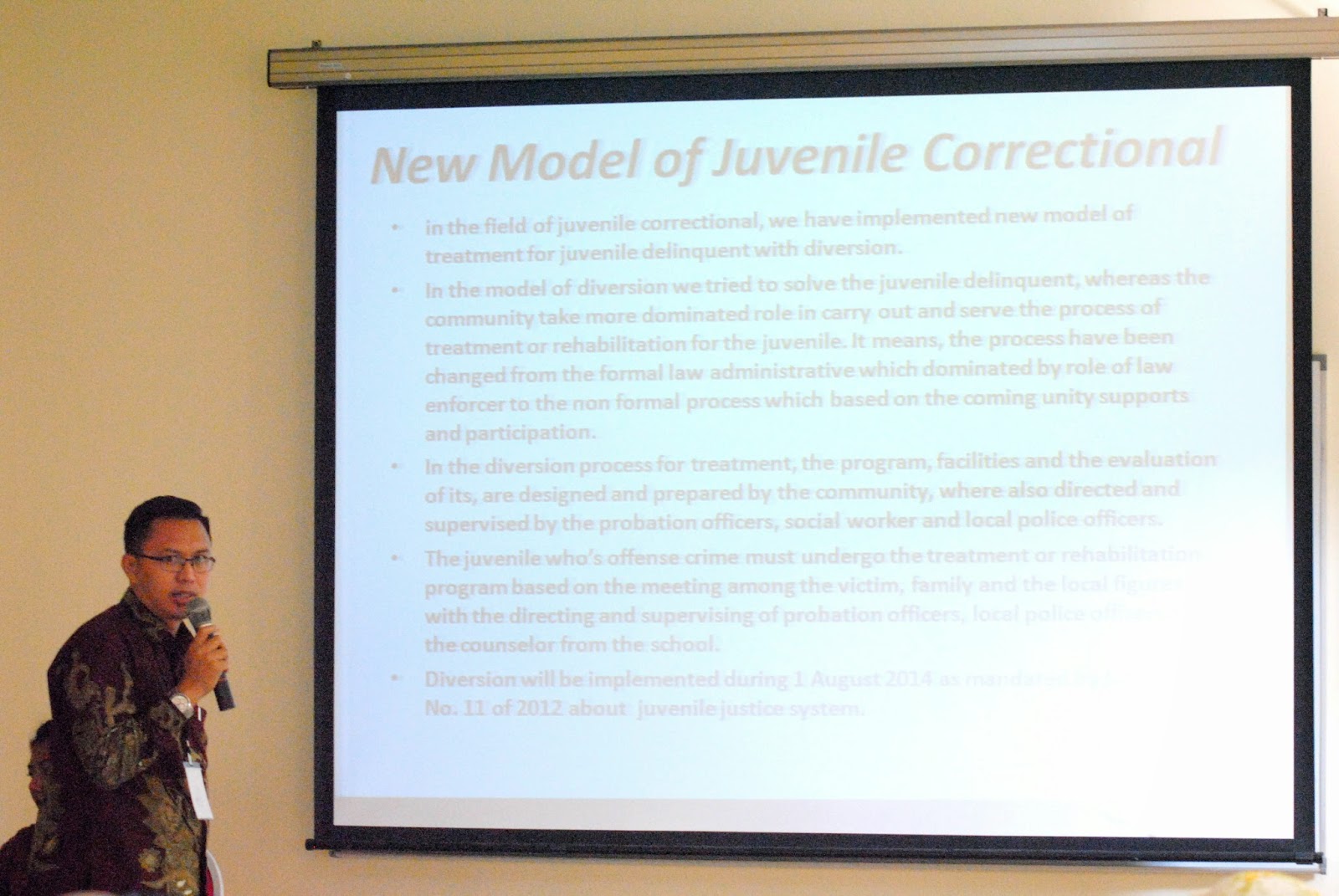
First, in the field of juvenile correctional, we have implemented new model of treatment for juvenile delinquent with diversion.
In the model of diversion we tried to solve the juvenile delinquent, whereas the community take more dominated role in carry out and serve the process of treatment or rehabilitation for the juvenile. It means, the process have been changed from the formal law administrative which dominated by role of law enforcer to the non formal process which based on the coming unity supports and participation.
In the diversion process for treatment, the program, facilities and the evaluation of its, are designed and prepared by the community, where also directed and supervised by the probation officers, social worker and local police officers.
The juvenile who’s offense crime must undergo the treatment or rehabilitation program based on the meeting among the victim, family and the local figures with the directing and supervising of probation officers, local police officers also the counselor from the school.
Diversion will be implemented during 1 August 2014 as mandated by Juvenile Act  No. 11 of 2012 about  juvenile justice system.
Second; Community Based Correction also implemented in the treatment for inmate who sentenced with probation. In this way, the program of treatment for the inmate is conducted with cooperation between the probation officer with the community. In some case or program, the community which represented as local organization or entrepreneur group. In Indonesia we call small business scale or home industry who interested and well respect to take part in the program for life skill training to the inmate.
Third ; In the program for treatment of inmate in the prison especially for the inmate who has passed their half of sentence, the officers have been usually to invite for the community participation.
The practice is the inmate who have good skill in such of professional competence will employed in the community business center. Another ways, is the inmate with good skill in car repair will be assigned in the car reparation who owned by personal or group of business.
Actually the inmate just will be employed just in the afternoon, and then back to the prison at evening the guard of officers.
Fourth; In the field of parole correctional service, its show how community play more strategic role and contribution to the process of correctional for the inmate/client.
The community actively make some program to supervise and secure the progress of personality and life skill development to the inmate. In practical, the client will be put on the process of training and apprentice in the business and entrepreneurship which managed by the community both personally or collectively.
All the process of training and apprentices for the inmate, actually undergoing by the agreement among the Probation Office with the representative of the community organization.

Correctional Data Based System 
Indonesian corrections realize that Information system is one of key factors in management of prison. That is why correctional information system always be improved time to time. Directorate General of Corrections is proud that a comprehensive system is running. This system consists of data collection and data information. This system provides a strong support to Directorate General of Corrections in making policies. 

CHALLENGES :

1.    Over capacity
- Limited Space;
- Placement
2. Human Resource ; quantity and quality
3. Special treatment
- Special rehabilitation program
- Determine and create intervention program
4. Security and order
5. Terrorist Inmates Behaviour
6. Corruption inmates
7. Narcotics inmates.

Conclusion To conclude, to achieve the correctional goals, all resources have to be optimize. Management should encourage and help corrections human resource to show their best performance and facilities have to be improved to support the security and treatment system. The last but least, community is key partner in treatment of offenders, without community involvement impossible to get the social reintegration.


Minggu, 28 Juli 2013

Video Pengakuan Vanny tentang BILIK ASMARA di Lapas Narkotika Cipinang

My Comment :
Berdasarkan Video diatas, ada beberapa hal yang dapat saya simpulkan sebagai berikut :

  1. Vanny berkunjung ke Lapas Narkotika Cipinang tanpa melalui prosedur kunjungan yang resmi, dia bisa dengan leluasa melewati pintu portir tanpa dilakukan pemeriksaan;
  2. Vanny melakukan kunjungan di lantai II Gedung II yang diakuinya sebagai Ruang Ka. Lapas. Padahal ruang Ka. Lapas berada di gedung I Lantai II di area depan Lapas;
  3. Vanny mengunjungi Freddy dalam seminggu bisa sampai 3 kali dengan durasi dari jam 11 siang hingga jam 5 atau 6 sore;
  4. Apabila ingin pesan makanan Vanny dialayani oleh orang yang dia sebut "Kaki Tangan" Freddy yang tidak lain adalah narapidana yang dipercaya oleh Freddy alias anak buah Freddy;
  5. Vanny berkunjung tetap membawa HP walau tidak ada signal (SOS). HP ditahan oleh petugas apabila petugas tersebut tidak kenal Vanny, sehingga apabila HP mau diambil maka haris ditebus dalam kisaran 1 Jt rupiah;
  6. Freddy di dalam lapas menggunakan HP dengan jaringan CDMA untuk menghindari efek Jammer (pengacak signal) yang ada di lapas.

Inilah Foto-foto "Bilik Asmara di Lapas Cipinang"

JAKARTA, KOMPAS.com - Vanny Rossyane menunjukkan bukti-bukti adanya bilik asmara di Lembaga Pemasyarakatan (Lapas) Cipinang berupa serangkaian foto. Di situlah ia mengaku sering melakukan hubungan seksual dan menikmati sabu bersama-sama.
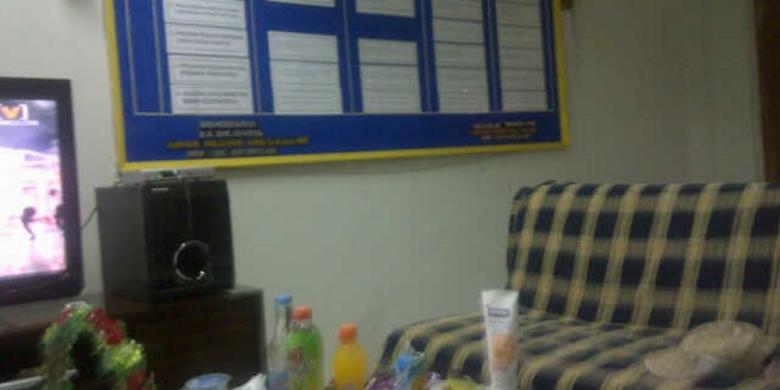
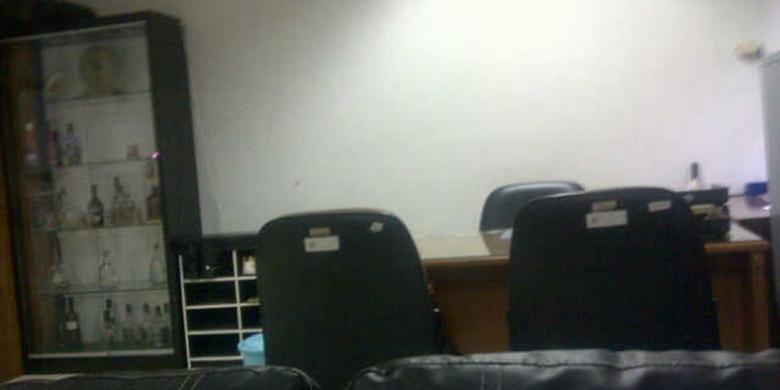
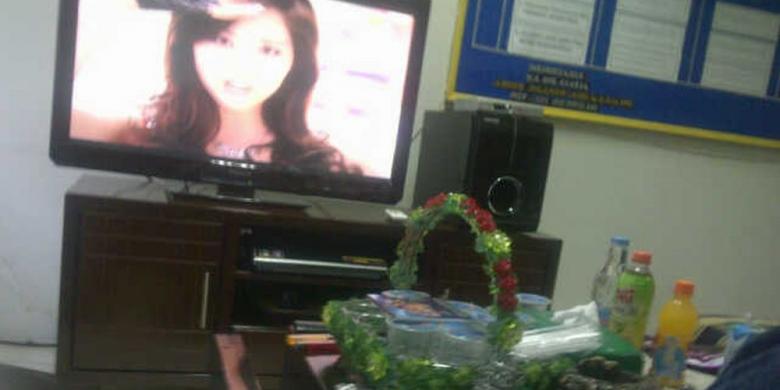
Di dalam foto-foto tersebut terlihat sejumlah perabot seperti kursi dan meja kerja, televisi layar datar, sofa, dan papan informasi.

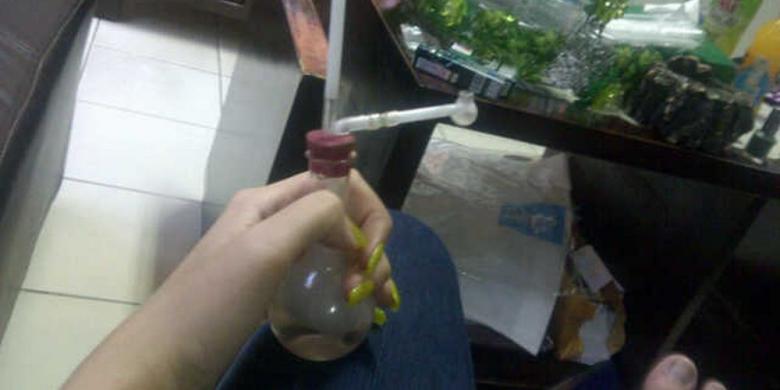
Bahkan, di salah satu foto terlihat tangan seseorang memegang bong atau alat isap sabu. Vanny mengaku itu tangannya sendiri.
Dalam berbagai kesempatan wawancara di televisi ataupun di sejumlah media, Vanny menyebut itu ruangan Kepala Lapas. Ia dan Freddy diberi kebebasan menggunakannya setiap kali berkunjung, bahkan mengunci pintu dari dalam.
Namun, hal tersebut dibantah Kalapas Cipinang Thurman Hutapea yang kini dinonaktifkan menyusul terkuaknya kasus tersebut.
Kasus dugaan adanya bilik asmara di Lapas Cipinang saat ini dalam penyelidikan Kementerian Hukum dan HAM.
Di dalam ruangan yang menurut pengakuan Vanny Rossyane sering digunakan untuk bermesraan dengan terpidana mati Freddy  Budiman terdapat papan informasi. Vanny menyebut ruangan itu adalah ruang Kalapas.
Di bilik asmara Lapas Cipinang yang disebut Vanny Rossyane juga terdapat sofa panjang layaknya ruang tamu.
Di dalam ruangan yang disebut bilik asmara di Lapas Cipinang terdapat televisi layar datar.
Sumber : KOMPAS.COM
My Comment :
Ruangan tersebut jelas bukan merupakan ruang Ka.Lapas. benar memang ruangan tersebut adalah salah satu ruangan yang ada di Lapas Narkotika. Jadi menurut saya pengakuan Vanny tentang adanya ruangan yang dipergunakan sebagai bilik asmara dirinya dan Freddy Budiman faktanya memang tak terbantahkan dan ini dilakukan oleh "oknum" dan bukan oleh seluruh petugas, masih banyak petugas yang berintegritas tinggi disana. Sangat disayangkan ulah segelintir "oknum" berdampak pada penonaktifan Ka. Lapas yang jelasjuga bahwa ruangan yang digunakan bukannlah ruang Ka.Lapas. 
Semoga kejadian ini menjadi cambuk insan Pemasyarakatan untuk lebih baik dan memahami bahwa tidak ada waktu lagi untuk main-main, bekerja ala kadarnya (work as ussuall) bahkan melanggar aturan. Dengan kejadian ini pula semoga pola karier petugas menjadi fokus perhatian para pemangku kebijakan, tempatkanlah orang yang tepat pada posisi yang tepat bukan orang yang tepat tapi pada posisi yang salah.

Minggu, 14 Juli 2013

Yusril Ihza Mahendra : Nasehat Untuk SBY

Soal Lapas: Nasehat untuk SBY

Saya ingin memberi masukan dan kritik kepada Presiden Susilo Bambang Yudhoyono terkait Lembaga Pemasyarakatan.

Sebenarnya yang harus dipenuhi bagi napi bukan hanya hak-hak dasar napi sebagai manusia, tetapi hak-hak napi itu sendiri. Hak-hak napi itu diatur dalam Konvensi PBB tentang Perlakuan terhadap Narapidana dan detilnya diatur dalam Protokol Tokyo. Isi Konvensi PBB itu sudah dituangkan dalam UU Pemasyarakatan Tahun 1995.

Hak-hak napi itu antara lain Hak Mendapat Remisi, Hak Cuti Menjelang Bebas, Mendapat Asimilasi, Hak Mendapat Bebas Bersyarat dan sebagainya. Namun, hak-hak itu diketatkan dengan Peraturan Pemerintan Nomor 99 Tahun 2012 untuk Napi-napi tertentu. Padahal perlakuan terhadap Napi tidak boleh ada perbedaan. http://www.kemendagri.go.id/media/documents/2012/12/13/p/p/pp_no.99-2012.pdf


Pengetatan bahkan penghilangan atas hak-hak tersebut menimbulkan keresahan yang meluas hampir di semua Lembaga Pemasyarakatan. LP Tanjung Gusta hanya awal saja. Petugas LP juga dibuat pusing dengan PP 99/2012 karena terkesan bahwa kita mulai meninggalkan sisem pemasyarakatan, kembali ke sistem penjara.

Penjelasan Presiden di Halim kemarin hanya mengemukakan agar hak-hak dasar napi dipenuhi. Hak dasar napi berbeda dengan hak-hak napi. Presiden sebaiknya minta Menkumham menjelaskan perbedaan hak-hak dasar napi sebagai manusia dengan hak-hak napi, agar dapat memahami persoalan.

Presiden harus menegur Menkopohukam yang menyebut Terorisme, Narkotik, Korupsi dan sebagainya sebaga "extra ordinary crime" terkait dengan PP 99/2012. Minta Menkopolhukam membaca Statuta Roma tentang Pembentukan ICC dan berbagai literatur tentang crime against humanity agar dapat memahaminya. Presiden juga harus menegur Menkumham dan Wamennya agar pahami betul-betul UU Pemasyarakatan dan sistemnya, agar tidak salah membuat kebijkan.

Kalau Pemerintah mau kembali ke sistem penjara seperti zaman kolonial dulu, silahkan saja. Siapa tahu Pemerintah sekarang ini menganggap sistem penjara kolonial lebih baik dari sistem pemasyarakatan. Jika itu yang dimaui, ajukan RUU untuk cabut UU Pemasyarakatan dan berlakukan lagi Reglement Penjara Hindia Belanda dulu itu. Dengan berlakunya kembali Reglement Penjara, maka tidak ada persoalan lagi dengan PP 99/2012 yang sejak 13 Juni lalu sedang diuji di Mahkamah Agung Republik Indonesia.

Sekian masukan dan kritik saya terhadap Lembaga Pemasyarakatan. Salam hormat saya Yusril Ihza Mahendra.


Sumber : Facebook Yusril Ihza Mahendra

Kamis, 11 Juli 2013

Menkum Heran dengan Tuntutan Napi LP Tanjung Gusta Soal PP 99


Jakarta - Menteri Hukum dan HAM Amir Syamsuddin keheranan dengan tuntutan para napi soal PP 99/2012. Padahal PP itu berlaku untuk kejahatan khusus yakni korupsi, narkoba, dan terorisme. PP itu mengatur bahwa kejahatan khusus tak mendapat remisi atau pengurangan hukuman kala hari besar keagamaan atau hari kemerdekaan.

"Ini ada ekses, ada yang menyalahkan PP 99, saya kurang memahami ini. Saya kira perlu diselidiki dari motif diangkatkan permasalahan ini oleh para napi," jelas Amir saat dikonfirmasi detikcom, Jumat (12/7/2013).

Amir menerangkan, untuk kasus narkoba, mereka yang hukumannya di bawah 5 tahun, PP 99 ini tak berlaku ketat. Karena biasanya mereka pemakai, sehingga lebih didorong agar direhabilitasi.

"Kemudian napi koruptor dari data statistik juga hanya 2 persen dari jumlah narapidana. Ini perlu diketahui motif di belakangan tuntutan ini," jelas Amir.

Rusuh terjadi di LP Tanjung Gusta, Kamis (11/7) pukul 17.00 WIB. Napi marah karena air dan listrik padam. Mereka kemudian melakukan aksi pembakaran. Di saat chaos itu, ada napi yang kabur. Belum pasti berapa jumlahnya. Kabarnya sampai ratusan orang.

Sumber : DETIK.COM

Catatan : Napi koruptor memang cuma hanya 2 % dari total keseluruhan penghuni, tapi yang perlu diingat bahwa jumlahnya bisa minoritas tapi kekuatan mereka mayoritas. Itu mungkin yang perlu dipahami oleh pemangku kebijakan negeri ini.  Remisi adalah salah satu hadiah yang begitu diidam-idamkan oleh narapidana, isu perubahan sedikit akan merubah persepsi mereka terhadap aturannya dan beban itu dipegang dipundak petugas PAS yang ada di lapangan, nyawa adalah taruhannya.

Rusuh di LP Tanjung Gusta Medan

Rusuh LP Tanjung Gusta, Dua Jenazah Dipastikan Petugas Sipir


Jakarta - Lima mayat berhasil dievakuasi dari dalam LP Tanjung Gusta, Medan yang dibakar oleh para napi. Dua di antaranya dipastikan adalah petugas sipir LP tersebut.

Juru Bicara Ditjen PAS, Akbar Hadi mengatakan, petugas sipir yang tewas tersebut yaitu Kepala Seksi (Kasi) Registrasi, Bona Situngkir dan Staf Registrasi, Richardo Naibaho. 

"Kasi Registrasi dan 1 staf registrasi meninggal dunia," ujar Akbar Hadi kepada detikcom, Jumat (12/7/2013).

Akbar mengatakan, proses identifikasi korban hingga kini masih berlanjut. Sebab masih ada beberapa mayat yang belum bisa dipastikan identitasnya.

Sejauh ini, korban akibat kerusuhan dan pembakaran LP Tanjung Gusta berjumlah lima orang. Empat mayat sebelumnya dibawa ke Rumah Sakit Umum (RSU) Pirngadi, Medan untuk diotopsi.

LP Tanjung Gusta dibakar oleh para napi pada Kamis (11/7) pukul 18.30 WIB kemarin. Akibatnya sekitar 200 tahanan kabur, sebagian kini sudah ditangkap. Polisi hingga kini masih belum bisa masuk ke dalam LP yang dihuni oleh 2.000 lebih napi karena napi masih berupaya melakukan perlawanan.


Korban Luka Akibat Ledakan karena Ingin Selamatkan Dokumen


Medan - Korban luka akibat ledakan di dalam Lembaga Pemasyarakatan (LP) Tanjung Gusta, Medan, diketahui bernama Awi. Dia berstatus sebagai tahanan pendamping.

Salah seorang petugas keamanan LP, Gabriel Siregar mengatakan Awi sedang berusaha menyelamatkan dokumen LP.

"Dia mau menyelamatkan dokumen, terkena ledakan," kata Siregar kepada wartawan di LP Tanjung Gusta, Jalan Pemasyarakatan, Medan, Jumat (12/7/2013) dinihari.

Untuk sementara ini, Awi menjdi satu-satunya korban luka berat yang terdeteksi. Dalam keadaan terluka bakar hebat, dia dievakuasi ke rumah sakit beberapa jam lalu.

Ledakan kuat terdengar dari dalam LP sekitar 20.47 WIB. Seiring dengan ledakan itu, api berkobar hebat. Ledakan itu berasal dari gas elpiji yang menjadi senjata para napi.

Sementara kondisi di LP Tanjung Gusta hingga pukul 03.00 WIB dini hari ini masih dikuasai para napi. Para napi menuntut untuk bertemu Wamenkum HAM Denny Indrayana.

Sumber : DETIK.COM